Lane 1 — Forensic Practice Analysis
Your Buyer Already Knows
What Your CPA Doesn't.
The Practice Management Software contains the evidence. You don't have the interpretive layer. Your buyer does.
The Problem
The gap between perceived profitability and forensic profitability.
The CPA audits the P&L. The buyer audits the clinical data. Those are not the same audit. Your CPA was trained to protect you from the IRS. A PE buyer's QoE team was trained to find what your CPA missed.
The Practice Management Software is not a command center. It is a raw data source — a digital crime scene. It records what you billed. It does not record whether what you billed will survive institutional review.
The gap between perceived profitability and forensic profitability is where most of the deal risk lives. That gap is not technical. It is structural. And it does not close on its own.
How a PDA Engagement Works
Five phases. One forensic outcome.
Phase 01 — Qualification & Intake
- ▸ Practice profile reviewed: PMS system, department structure, provider count, exit horizon, engagement objective
- ▸ Engagement scope confirmed: Lane 1 Forensic Analysis or Lane 2 Data Room Build
- ▸ Remote access parameters established with practice administrator
Phase 02 — Remote Extraction
- ▸ Secure remote session into client's existing PMS environment
- ▸ Native reporting architecture used — no integrations, no third-party tools, no persistent connection
- ▸ Extraction covers: production by code by provider, insurance AR aging, payer mix, patient retention, fee schedule, case acceptance, new patient pipeline
- ▸ Session closed upon completion. No data left resident on external systems.
Phase 03 — Forensic Analysis
- ▸ All extracted data normalized against PDA's 2,500-practice national benchmarking database
- ▸ EBITDA normalization bridge constructed: hard addbacks, soft addbacks, owner comp adjustment, QoE risk deductions applied
- ▸ Clinical compliance benchmarking conducted against Cotiviti and ADA national benchmarks
- ▸ Phantom EBITDA quantified across all applicable categories
- ▸ All 11 KPI domains scored with percentile rankings
Phase 04 — Deliverable Preparation
- ▸ Practice Intelligence Brief prepared
- ▸ All practice identifiers sanitized per confidentiality protocols
- ▸ Three-scenario valuation architecture constructed: Risk, Baseline, Optimized
- ▸ Remediation roadmap developed for all HIGH and MODERATE findings
Phase 05 — Briefing & Handoff
- ▸ Findings presented to client, broker, and/or M&A advisory team
- ▸ All data sources, methodology, and assumptions documented for QoE defensibility
- ▸ Remediation priorities sequenced by enterprise value impact
- ▸ Engagement closed. All extracted data purged per retention policy.
What We Measure
11 Domains. 2,500-Practice Baseline. Your Exact Position.
Every domain is benchmarked against PDA's national database and scored by percentile. This is not a subjective assessment. It is a mathematical position.
Marketing & Patient Acquisition
New patient pipeline, referral source attribution, cost per acquisition by channel
Appointment & Schedule Efficiency
Completion rates, broken appointment benchmarking, schedule utilization
Clinical Production
Billable procedures by provider, adjunctive attachment rates, capacity utilization
Clinical Compliance Benchmarking
Procedure ratios vs. Cotiviti, crown-to-buildup ratio, code anomaly detection
Hygiene Department
Perio diagnosis rate, adult fluoride attachment, SRP utilization, reappointment rate
Patient Retention
Reappointment rates, unscheduled patients by timeline bucket (0–6, 6–12, 12–18, 18+ months)
Collections & AR
AR aging, payer-level anomaly detection, 120+ day reserve exposure, claims over 30 days
Case Acceptance
Treatment presented vs. accepted, financing utilization, provider-level variance
Fee Schedule Analysis
Office fees vs. 75th percentile CDT benchmarks, code-by-code gap analysis
EBITDA Normalization
Full normalization bridge, hard/soft addbacks, QoE risk deductions, defensible baseline
Valuation Architecture
Three-tiered scenario modeling, enterprise value range, Phantom EBITDA at multiple
The Deliverable
The Practice Intelligence Brief
The output of every Lane 1 engagement is a Practice Intelligence Brief — a structured, confidential document designed to serve as the evidentiary foundation for pre-LOI positioning, QoE defense preparation, and exit architecture.
The brief below is a sanitized example from a completed engagement on a multi-specialty Southern California group practice generating $12.2M in annual production. The Phantom EBITDA identified: $620,580. Enterprise value at risk: $3.7M at 6x.
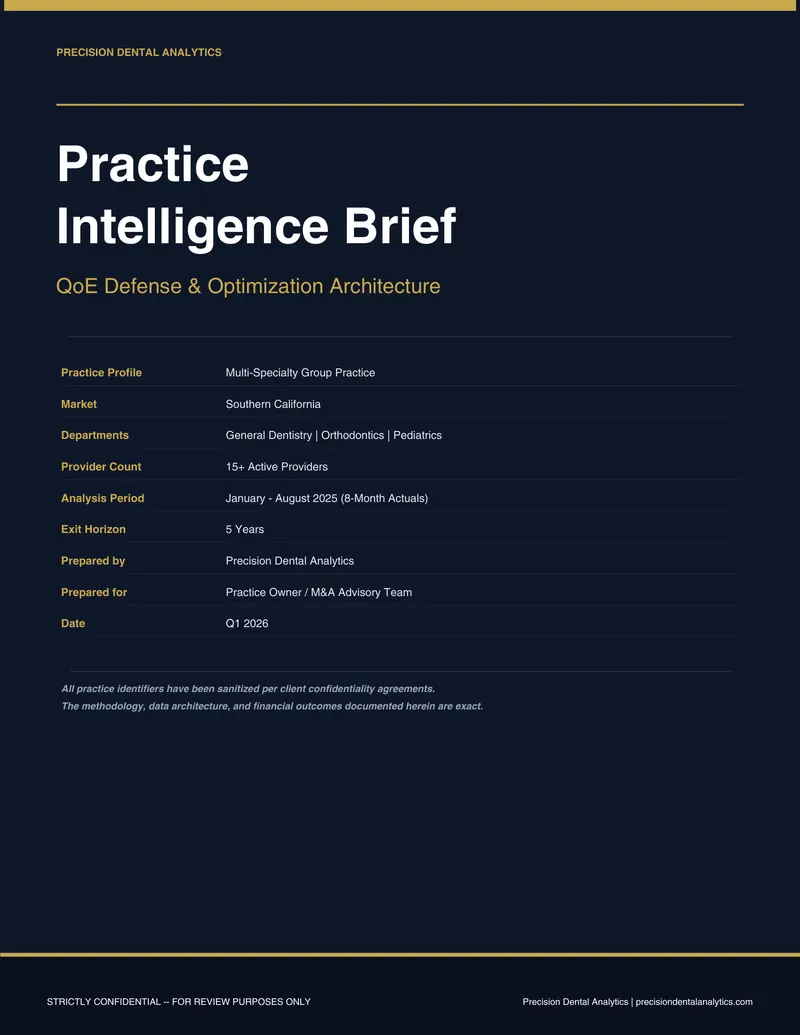
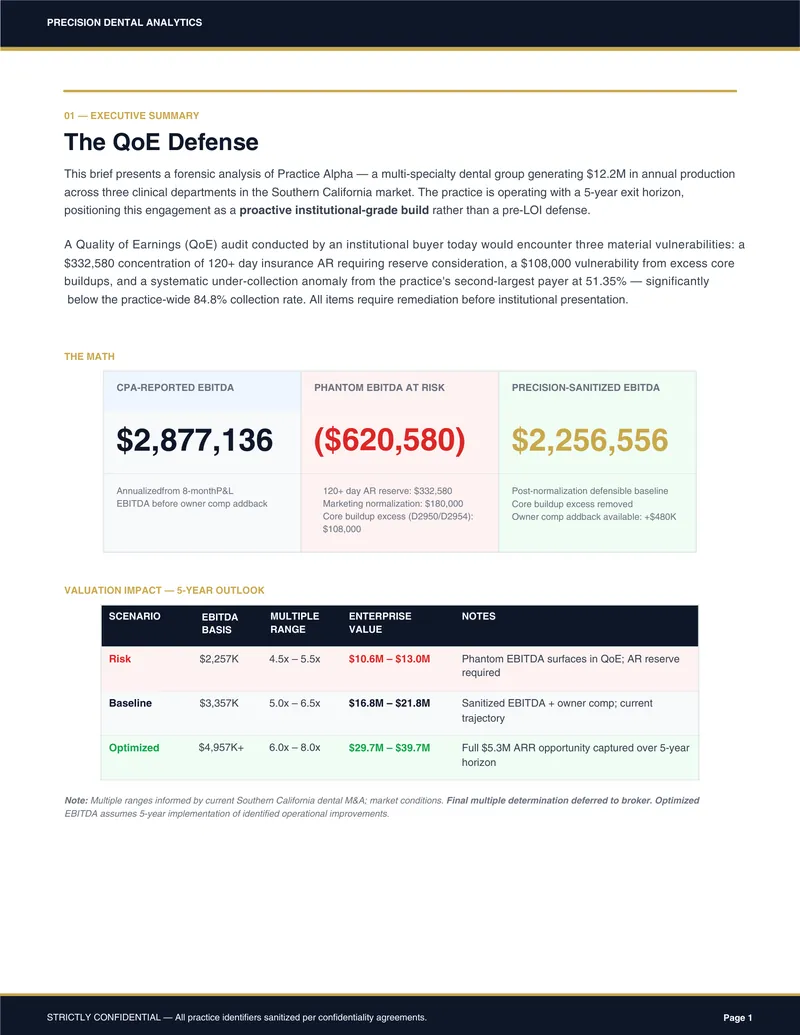
Full 12-page brief: executive summary, revenue architecture, payer mix forensics, and EBITDA normalization bridge.
Download Full Sample Brief →Who This Is For
This Engagement Is Not For Everyone.
Practice owners with a defined exit horizon of 2–5 years who want to control the data narrative before a buyer does.
M&A advisory teams and brokers who need institutional-grade forensic validation before bringing an asset to market.
PE-referred practices requiring sell-side QoE preparation before entering exclusivity.
If you are 90 days from signing an LOI, this is not the engagement for you. The forensic audit takes time. The remediation takes longer. The window you needed was 18 months ago.
Frequently Asked Questions
Forensic Analysis FAQ
What data does PDA extract during a forensic analysis?
+
We extract directly from your PMS: production by code by provider, insurance AR aging, payer mix, patient retention, fee schedule, case acceptance, and new patient pipeline data. No third-party tools or integrations required.
How long does the forensic analysis take?
+
The full engagement runs 2-4 weeks from intake to briefing. Remote extraction takes 1-3 hours. Analysis takes 5-10 business days. Deliverable preparation takes 3-5 business days. The briefing is a 60-minute session.
What is a Practice Intelligence Brief?
+
The Practice Intelligence Brief is the structured, confidential deliverable from every Lane 1 engagement. It includes a full EBITDA normalization bridge, clinical compliance benchmarking, three-scenario valuation architecture, and a remediation roadmap — designed to serve as the evidentiary foundation for QoE defense.
How is PDA different from my CPA or financial advisor?
+
Your CPA audits the P&L. A buyer audits the clinical data. Those are not the same audit. PDA extracts ground-truth data from the Practice Management Software — procedure-level, code-level, provider-level — and benchmarks it against 2,500 practices. Your CPA does not have this data or this baseline.
Do I need to be actively selling my practice to benefit from forensic analysis?
+
No. The ideal window is 2-5 years before exit. Practices that engage early have time to remediate findings and build clean, benchmarked performance data. Practices that engage 90 days before LOI have a diagnosis but no time to fix it.
The Next Step
Schedule a Pre-LOI Briefing
Confidential intake. Responded to within 48 hours.