The Boutique Fallacy: Why Size Sets Your Dental Practice Value
Two practices. Same zip code, same procedures, same dentist’s dream.
The first runs at a 40% EBITDA margin, immaculate systems, an elite solo team, the kind of boutique efficiency most owners would kill for.
The second is bigger, but heavier: more chairs, associate payroll, corporate overhead, and a thinner 25% margin.
Ask most dentists which one is worth more and they’ll point at the 40% margin. They’d be guessing at a question they don’t realize has two different answers. Because those two practices aren’t competing in the same market. And the thing that decides which market you’re in isn’t your margin. It’s your scale.
There are two markets for a dental practice, not one
When a practice changes hands, it gets priced one of two completely different ways.
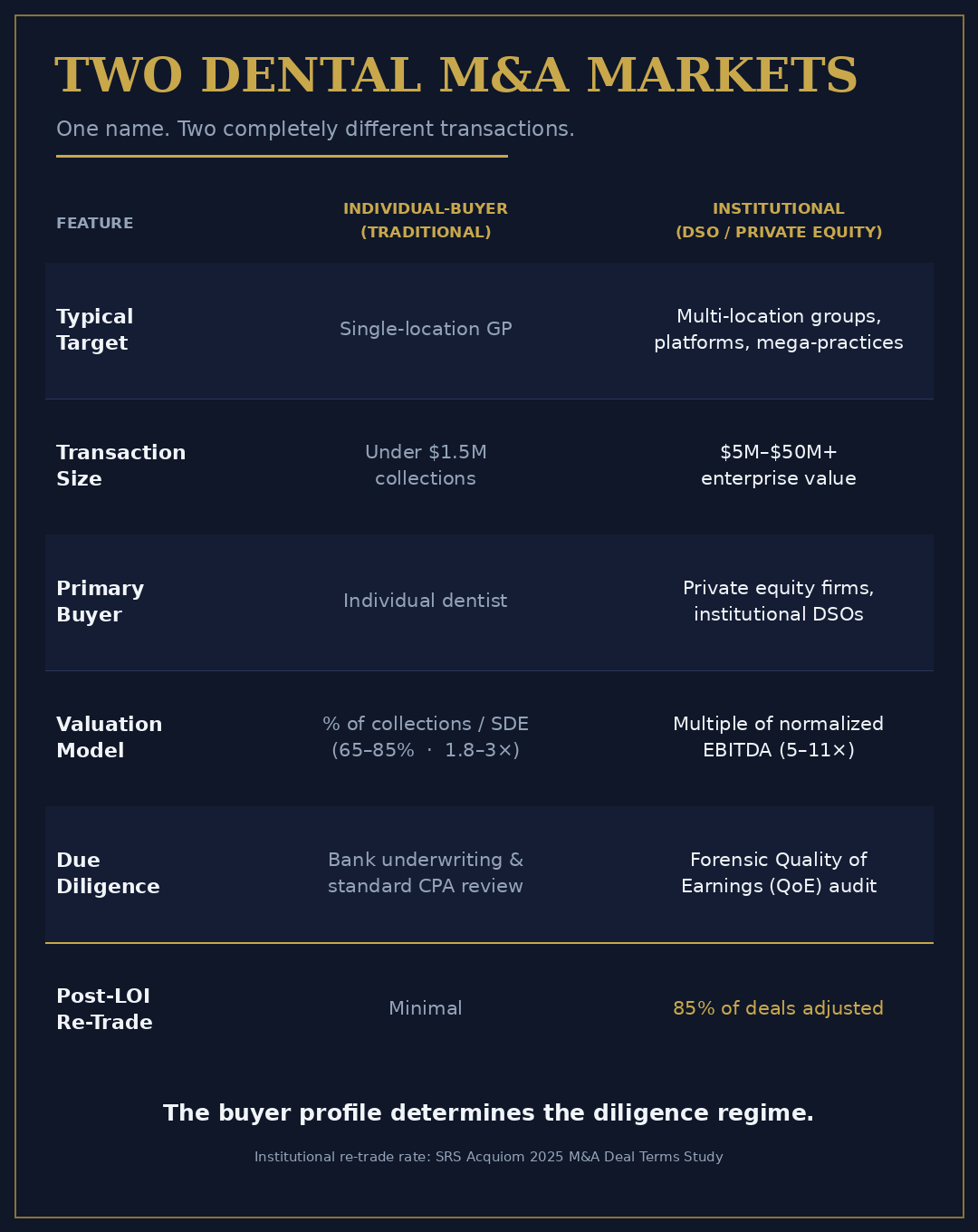
The first is the individual-buyer market. The buyer is another dentist, or a small group. They value the practice on Seller’s Discretionary Earnings (SDE) — your profit with the owner’s full compensation added back, because the buyer is going to step into the chair and do the producing themselves. SDE multiples for dental practices run roughly 1.8× to 3×.
The second is the institutional market. The buyer is a DSO or a private-equity-backed platform. They don’t care what you earn standing at the chair — they’re buying a business that runs without you, so they value it on normalized EBITDA: your profit after resetting owner pay to a market associate rate. Institutional EBITDA multiples run far higher — 5× to 11× and beyond.
These are not two points on one spectrum. They are two different pricing regimes, with different buyers, different math, and different multiples. The same practice, the same profit, gets a fundamentally different number depending on which market it sells in.
The boundary is size — and it’s a hard line
Here’s the part nobody tells the seller: you don’t choose your market. Your size chooses it for you.
- Below roughly $1.5M in collections, you’re almost always an individual-buyer asset, valued on SDE — no matter how clean your margins are.
- Clear seven figures of EBITDA and you’re valued on the institutional EBITDA ladder.
- Reach $3M–$5M of normalized EBITDA and you become a platform — the tier that commands the richest multiples.
The institutional ladder, in the current market, looks like this:
| Normalized EBITDA | Typical multiple | What you are |
|---|---|---|
| Near $1M | 5–7× | Add-on / individual-buyer |
| $1M–$3M | 7–9× | Regional add-on |
| $3M–$5M | 9–11× | Emerging platform |
| $5M+ | 11×+ | Platform |
(Multiple ranges per FOCUS Investment Banking, 2026.)
Below that ladder entirely sits the SDE market, where a small practice is priced at a fraction of its collections — regardless of how well it runs.
Why quality can’t buy its way across the line
Run the elite small practice through the math.
Say it collects $1.5M at a 40% normalized EBITDA margin — about $600K of EBITDA. Genuinely excellent. But at $1.5M in collections, it sits below the institutional threshold. It gets valued on SDE, not on a 7× EBITDA multiple — which lands it around $2–2.5M in enterprise value, not the $3M-plus the owner assumed when they heard what DSOs “pay”.
Now take a larger, less-polished practice — a thinner 25% margin, but $4M+ in collections and over $1M of normalized EBITDA. By clearing the seven-figure EBITDA mark, it crosses the boundary into the institutional market. That $1M of profit is no longer multiplied by an individual-buyer SDE fraction; it commands an institutional 5× to 7× multiple.
The elite 40% margin practice sells for $2.5M. The 25% margin practice sells for $5.0M to $7.0M.
Look closely at the math: Practice B only generates $400,000 more in profit than Practice A. But because that $400,000 pushes the asset across the institutional threshold, it creates up to $2,500,000–$4,500,000 in additional enterprise value.
The valuation multiplier just outpaced the collection growth.
This is the uncomfortable truth: Quality maximizes your value within your current market. Only scale moves you into a different market. A perfect $600K EBITDA practice is a perfect individual-buyer asset. It is not a platform, and no amount of polish will make it one.
The market you’re in also decides how hard you get audited
The two markets don’t just price differently — they scrutinize differently. And that’s the part that costs sellers at the closing table.
In the individual-buyer market, due diligence is bank underwriting and a standard CPA review. The buyer’s lender wants to know the cash flow covers the note; the CPA confirms the tax returns are clean. Re-trades are rare, because nobody is running a forensic audit hunting for reasons to cut the price.
Cross into the institutional market and the regime changes entirely. A DSO or PE buyer commissions a forensic Quality of Earnings (QoE) audit — pulling raw production data, re-pricing every add-back, benchmarking your clinical coding against carrier databases. It is built to find what the headline number is hiding. Which is why 85% of lower-middle-market deals see a post-LOI price adjustment (SRS Acquiom, 2025) — almost always downward.
So the bigger multiple comes with a forensic audit attached. Growing into the institutional market is the right move for the right practice — but it means the EBITDA you built has to survive scrutiny the traditional market never applies. The multiple is bigger; so is the microscope.
What this means before you go to market
The most expensive mistake a founder makes is assuming the DSO multiple applies to an SDE asset, or assuming SDE-level diligence applies to a DSO exit.
Years before you sell, you must align your architecture with your destination:
- If you remain an individual-buyer asset: Maximize your SDE. Optimize case acceptance, hygiene retention, and fee schedules to drive your cash flow as high as possible. Your buyer is an associate, and your judge is a bank.
- If you are crossing the institutional threshold: You are entering the kill-zone. The moment you clear $2M in collections and target a 6×+ multiple, your CPA-prepared financials are no longer sufficient. You must mathematically harden your clinical data, substantiate every add-back, and run your own internal QoE before the buyer’s forensic team arrives.
The number a buyer pays you isn’t your EBITDA multiplied by what you think you deserve. It is your earnings multiplied by the regime your size dictates. Know which market you are in before you sign an LOI. It is the difference between a number you are proud of, and a re-trade that breaks your exit.
The fallacy: you didn’t build a business, you built a job
Here’s where it gets uncomfortable.
Most dentists who land in the individual-buyer market didn’t get there by accident. They chose it, one comfortable year at a time. They picked the boutique practice over the bigger one. They favored the predictable day, the single location, the team they could see every morning. And every one of those choices was a choice to stay an owner-operator instead of becoming a CEO.
That feels like a lifestyle preference. Financially, it’s a valuation decision — made forty years before the sale.
Because an owner-operator practice is a very good job that you happen to own the equity of. The income depends on you being in the chair. The value depends on you being in the chair. Take you out and most of it leaves with you — which is exactly why the individual-buyer market prices it on SDE and the institutional market won’t touch it. You didn’t build a business. You built a job with your name on the lease.
And here’s the pushback I already hear: “I’d rather own the smaller, profitable one.”
Read that sentence again. You don’t want to own it — you want to operate it. Owning is holding an asset that produces value whether or not you show up. Operating is showing up. The dentist who would “rather own the small profitable practice” almost always means they’d rather keep working in it, on their own terms. That is a completely legitimate thing to want — but it is a job, and it pays like a job: a great salary for as long as you can stand in the chair, and a modest multiple when you can’t. Not a liquidity event.
None of this makes the boutique wrong. Plenty of dentists would trade two turns of multiple for the life they’ve built, and mean it. The fallacy isn’t choosing the job. It’s choosing the job while believing you’re building the business — and finding out the difference for the first time at the closing table, when the number meant to fund the next chapter turns out to be a multiple of you, not of something that runs without you.
So the real decision was never how to sell. It’s which of these you’ve spent your career actually building — and whether that’s the one you meant to.
The bottom line
The number a buyer pays you isn’t your EBITDA times a multiple. It’s your EBITDA times the multiple your market allows. Two practices with identical profit can sell for wildly different numbers, because one is an individual-buyer asset and the other is institutional — and the line between them is drawn in collections and EBITDA, not in quality.
Know which market you’re in before you set your expectations. It’s the difference between a number you’re proud of and a number that surprises you at the closing table.
Frequently Asked
Questions
- What is the difference between SDE and EBITDA when valuing a dental practice?
- SDE — Seller's Discretionary Earnings — is your profit with the owner's full compensation added back, the way an individual dentist buying a practice they will work in values it; SDE multiples run roughly 1.8–3×. Normalized EBITDA resets owner pay to a market associate rate, the way a DSO or private-equity buyer values a business that runs without you; institutional EBITDA multiples run 5–11×. Smaller practices sell on SDE, larger ones on EBITDA.
- At what size does a dental practice get DSO or institutional EBITDA multiples?
- Roughly $1.5M or more in collections to be valued on EBITDA at all, and $3M–$5M of normalized EBITDA to reach platform multiples. Below those thresholds, a practice is valued on Seller's Discretionary Earnings as an individual-buyer asset, no matter how strong its margin.
- Can a small, high-margin dental practice be worth less than a larger, lower-margin one?
- Yes. Size — not margin — sets which market and which multiple apply. A pristine 40% margin practice under the institutional threshold is valued on SDE, while a larger practice with a thinner margin can clear the threshold and earn an institutional EBITDA multiple. The smaller, more profitable practice can sell for millions less.
- How do I move my dental practice into the institutional (DSO or PE) market?
- Grow collections and normalized EBITDA past the size thresholds and reduce owner-dependency so the practice runs without you. Quality alone will not do it — a perfectly run small practice is still an individual-buyer asset. Only scale moves you into the higher-multiple institutional market, and the EBITDA you build there has to survive a buyer's Quality of Earnings audit.
- What EBITDA multiple will a DSO pay for a dental practice?
- Institutional multiples scale with EBITDA size: roughly 5–7× under $1M of EBITDA, 7–9× at $1M–$3M, 9–11× at $3M–$5M, and 11×+ above $5M (FOCUS Investment Banking, 2026). The platform tier — the richest multiples — generally requires $3M–$5M of normalized EBITDA.
- How are multi-location dental groups valued differently from single practices?
- They are priced in a different framework entirely. Single solo practices sell in the individual-buyer market at 1.8-2.7x Seller's Discretionary Earnings or 60-100% of collections. Multi-location groups that cross the institutional threshold are priced on normalized EBITDA: 5-8x as add-on acquisitions, and 9-11x as platform assets once normalized EBITDA reaches roughly $3-5M with centralized systems and management depth. The difference is not a bigger version of the same math — it is a different buyer pool, a different diligence process (three-year P&L plus five-year PMS audit), and a different definition of earnings. Size decides which game a practice is even playing.
- Is it better to own a small, profitable dental practice or grow a larger one?
- Both are valid, but they are different things. A small owner-operated practice is a high-paying job you own — strong income now, a modest SDE-based exit. A larger, owner-independent practice is a business — a real liquidity event at an institutional multiple. The mistake is not choosing the smaller one; it is choosing it while expecting it to sell like a business.
Related Resources
Forensic Tools
Quantify what this article describes.
Turn the concepts in this article into hard numbers with PDA's free diagnostic tools — the same frameworks used in our Practice Intelligence Briefs.
Free | Instant results
More from Financial Analytics
What Comes Off Your Number: The 14 Ways a Buyer Reprices a Dental Practice's EBITDA
In a dental practice sale, the add-backs list runs in reverse. The 14 adjustments a buyer's diligence team makes to EBITDA, grouped by what each comes off: the price, the terms, or the cash at close, with what each one costs at 7x.
The SBA Just Made Phantom EBITDA a Loan Condition
From October 1, a $3 million practice purchase financed through an SBA 7(a) loan needs an independent Quality of Earnings the seller can't supply. Here is what it will find, and what it won't.
The Three Faces of Phantom EBITDA
Phantom EBITDA has three faces: accounting, operational, clinical. Each is found by a different reader on the buyer's side and prices differently. One $10M practice, all three.

Next Step
Defend Your Enterprise EBITDA Before the LOI.
Pre-LOI Defense, QoE forensics, and M&A advisory for enterprise dental groups and DSOs. Confidential intake.
Enterprise & DSO | Confidential