Case File 001
The Profitability Paradox
Same team. Same building. EBITDA from ~$200K to ~$720K — and the breakthrough year added $473,845 in collections while patient visits declined.
All practice identifiers have been sanitized per client confidentiality agreements. The methodology, data architecture, and financial outcomes documented here are exact.
Normalized EBITDA
EBITDA Margin
Enterprise Value
Additional Staff
Practice Profile
Established general practice, Southern California. Owner with a military background — disciplined, and fiercely loyal to the team he had built.
Working six days a week, spouse alongside him at the practice. A team sized for a practice he had not yet become.
Strong top line, but margin trapped near 13% beneath hidden operational inefficiency. Every prior consultant gave the same answer: cut the team.
The Trigger
He was referred in for an analysis. The benchmark told a different story than the consultants had: the problem was never the people — it was that the practice had no system for how the work got done. His loyalty had rejected every "fire your team" pitch before, and rightly so. A systems approach, framed in the language of operational discipline he already understood, was different. He tried it.
The honest part of the story is that the real breakthrough came later. A year in, the numbers looked good on paper and he was down to five days — yet he still felt the team was making mistakes, and felt he had to climb back to six days to keep service smooth. He was right-ish. So we drew a line in the sand: he wanted the structure he had in the military, rebuilt for a civilian practice.
The Intervention — "Praetorian"
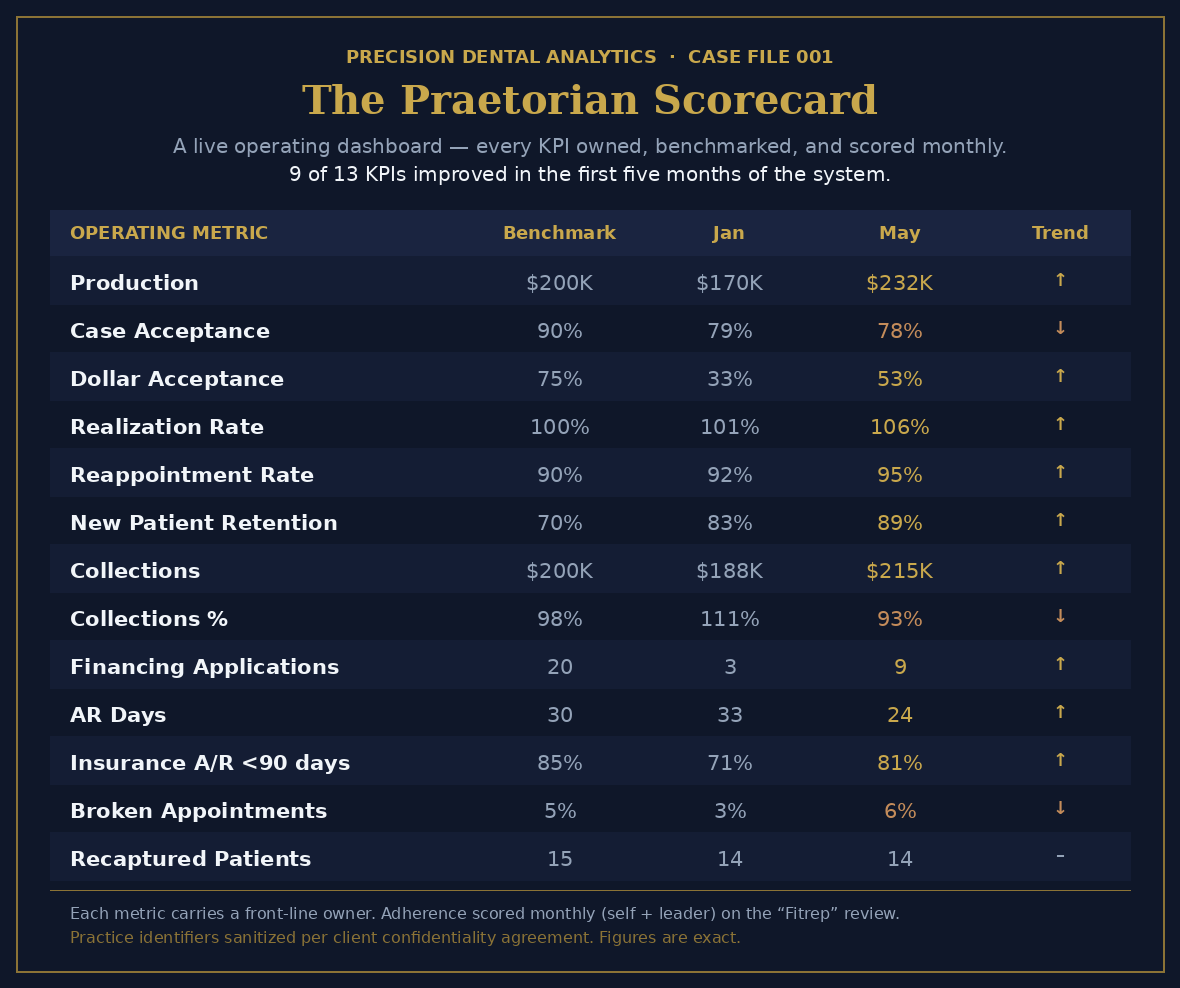
Praetorian is an OODA-loop operating system: a written SOP for every process in the practice, each one carrying a benchmark that acts as an alert. The forensic baseline surfaced ten off-target KPIs. Each was assigned a front-line owner; the scorecard split between the office manager (collections metrics) and the lead assistant (production metrics). The team was retrained to the SOPs, and the owner installed a monthly "Fitrep" review — adherence scored by self and leader, then discussed and personalized to each role. The structure he had been missing, rebuilt for a civilian practice.
The Outcome
The breakthrough year alone added $473,845 in collections without a single additional patient — the Profitability Paradox. Three years in, the arc is bigger: collections roughly $1.5M → $2.4M, normalized EBITDA ~$200K → ~$720K, margin 13% → 30%. Same team.
The owner went from sliding back toward six days a week to reclaiming real time off — because the system, not his presence, now holds the standard. As he puts it: the way people do things changed, not the number of people it takes to do them.
The Valuation Impact
Starting Value
~$920KOwner-dependent — priced on SDE (individual-buyer market)
Current Value
~$4.74MInstitutional EBITDA basis (~6.6×), range ~$4.2M–$5.3M
Run through our own valuation model, the work paid three ways:
Income now. The collected growth improved the owner's financial position immediately — cash in pocket, every year, before any sale.
Asset value at exit. Enterprise value moved from ~$920K to ~$4.74M — and crossed markets, from a practice an individual buyer would price on SDE to an institutional-grade EBITDA asset.
Defensible under diligence. The EBITDA increase is documented and owner-independent, backed by a live data trail — so a buyer's Quality of Earnings team inherits a system, not a key-person dependency.
"The way people do things changes — not the number of people it takes to do them."
— James DeLuca